


From problem to appropriate app
An app doesn't start with features. It starts with a clear benefit.
A good company app makes a recurring process easier: customers book faster, employees access information on the go or a digital offer becomes permanently available. Therefore, we first clarify which problem the application solves and for whom it is really relevant.
From Dillenburg, we help businesses across Europe plan, design and develop apps that integrate with existing systems. We work remotely and keep project communication in writing.
What should your app help people do?
You will get an initial classification, which type of app and which functions can be useful.
Meaningful areas of application
When a mobile app makes work easier
Not every digital offer needs an app. However, if people work regularly, on the go or with device functions, a mobile application can do much more than a responsive website.
Customer service app
Appointments, documents, status information, messages and personal services in one reliable location.
App for your team
Mobile processes for teams, field service, time tracking, tasks, releases or structured data collection.
Sales and bookings
Products, reservations, digital services, payments and recurring purchases with short user guidance.
Knowledge and platforms
Learning content, member areas, communities or specialist information that must also be quickly accessible on the move.
Functions and interfaces
Complex technology, simple to use.
A good app does not convince with as many individual modules as possible. What is crucial is that functions play together sensibly, can be operated in an understandable manner and reliably integrate existing systems.
Login and User Profiles
Roles, personal areas, secure login and content that is available to match the respective user.
Push notifications
Relevant clues, reminders and status changes that inform without interrupting unnecessarily.
APIs and third-party systems
Connections to WordPress, shops, CRM, booking systems, databases or existing corporate software.
Offline access and syncing
Selected data remain available on the go and are checked against the central system.
Mobile device functions
Camera, files, location or calendar are integrated where they create real added value.
Booking and payment
Clear purchase, reservation and payment processes, tailored to the business model and the audience.
Which functions your app really needs, we clarify in the digital project briefing and prioritize them according to benefits, effort and development level.
Description of functionsPlan your app project
From brief to app store launch.
Requirements, decisions, corrections and approvals are documented in writing, so that a technically demanding app project remains comprehensible for all parties involved.
Goals and requirements
We record audiences, usage situations, business model, functions, existing systems and requirements for data protection and operation.
UX, structure and prototype
User paths, navigation and central views are planned and coordinated as a clickable process before programming.
Development and integrations
The app, its data logic and required connections are created step by step. Test versions make progress tangible at an early stage.
Testing and store launch
We review real usage scenarios, prepare the publication and accompany the submission to the Apple App Store and Google Play.
App from Practice
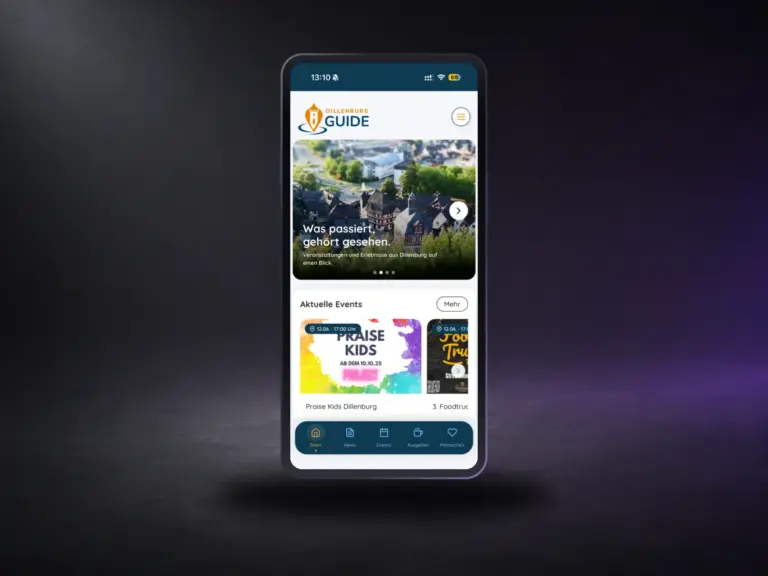
Local news, events and outings in one app.
The Dillenburg Guide bundles news, events and local offers in a citizen and city app. The reference shows conception, user guidance and data integration on the basis of a concrete project.
Frequently asked questions
What you should know before app development.
The most important answers to costs, platforms, publication, interfaces and support.
How much does it cost to develop an app for iOS and Android?
The costs depend mainly on user roles, functional scope, interfaces, data storage, design, platform strategy and necessary audits. After a structured briefing, you will receive a clearly defined range of services and a binding offer.
Is a native or a cross-platform app better?
This cannot be answered in general terms. Native development can be useful for highly platform-specific functions. A common codebase is often more economical when iOS and Android get largely the same range of functions. We justify the recommendation based on your project.
Can the app be connected to our website or existing software?
Yes, provided that the existing system provides or can be extended an appropriate interface. For example, connections to WordPress, shops, CRM systems, booking software, databases or own web applications are possible.
How long does an app project take?
A compact, clearly defined MVP can be created within several weeks. Extensive platforms with interfaces, different roles or complex data logic require more time. The project plan is realistically defined after the concept phase.
What happens after launch?
Upon request, we undertake technical maintenance, error corrections, adjustments to new operating system versions and step-by-step development. Scope and reaction times are agreed to match the meaning of the app.
How do we give feedback and approve work without calls?
Requirements, queries, prototypes, test stands, corrections and approvals are coordinated by e-mail, digital briefing and, if necessary, via WhatsApp. As a result, decisions remain fully documented and traceable at all times.
Your App Idea
Turn your app idea into a project you can plan.
Describe us audience, most important task, desired platforms and existing systems. You will receive a personal written initial estimate within a maximum of 24 hours on weekdays.